
Over the last year and a half, Instagram has been slowly developing its platform around the needs of social influencers with huge followings, as opposed to around the feedback given by the majority of its users. It’s a really interesting strategy that no social platform other than YouTube has really managed to do well before, so let’s delve a little deeper into it:
Algorithm Change
In June 2016, Instagram rolled out a change to its feed, which would show users’ the posts that they were likely to want to see first, rather than the old style of chronological order. As with all social platform changes, there was uproar. Influencers in particular were worried that their followers would no longer see their content, and urged everyone to turn on notifications for their posts.

However, it turned out that Instagram had actually optimised the feed for the type of highly engaging content that influencers produce. Large influencers(300k+ followers) saw an increased engagement rate of 24% following the introduction of the algorithm, while smaller influencers (10k-99k followers) saw an increase of 10%. This may have been an inadvertent result of Instagram trying to improve the quality of the feed for it’s users, but it proved that influencer content was what users wanted to see.
Instagram Stories
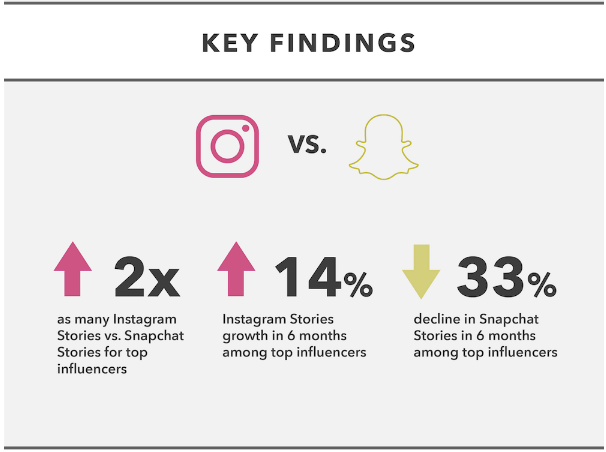
While the introduction of Instagram Stories in August 2016 wasn’t necessarily developed specifically for influencers, it has to be noted that it succeeded in convincing many influencers to make the switch from Snapchat to Instagram when it came to posting their daily content. This was helped in some part by Snapchat’s reluctance to engage with or support its content creators. BuzzFeed reported in March 2017 that many of the big Snapchat influencers were moving their following across to Instagram, primarily due to neglect. Instagram were quick to capitalise on this, and their Stories feature quickly grew to 250million daily users in less than a year
Swipe Up
In May 2017, Instagram Stories added a feature which allowed users to add a link to their Stories, so that their followers could Swipe Up to view a website of their choosing. This was initially rolled out to business and verified accounts, and as of October 2017 it’s available for all Instagram Stories users.


But who was this feature developed for? It wasn’t to catch up with a feature that Snapchat rolled out, as they only introduced Swipe Up in July 2017. It wasn’t for regular users – why would you share a link through Insta when you could do it much more conveniently through Facebook messenger? It wasn’t even for brands, as Instagram would rather they pay to advertise their links. In fact, Instagram had always avoided making links easily shareable, by not making them clickable in Insta captions.
The most plausible explanation is that Instagram saw the potential for growing its platform for influencers, and allowing them to add links would transform the relationship these influencers have with brands. By positioning itself as the go-to platform for brands to partner with influencers, Instagram not only overtook Snapchat as the leader of ephemeral influencer content, but it made it clear to brands and influencers alike that Instagram was willing to support their partnerships.
Paid Partnership
After the success of the Swipe Up feature, in June 2017 Instagram introduced the ability to tag an Instagram post as a “Paid Partnership”. This was following an FTC statement made in April advising that 90 social media stars had been contacted with a warning about violating FTC guidelines. The statement specified:
“The letters each addressed one point specific to Instagram posts – consumers viewing Instagram posts on mobile devices typically see only the first three lines of a longer post unless they click ‘more,’ which many may not do.”


While influencers had typically been using the #ad or #sp within their Instagram captions, they often appeared at the end of a lot of text which wasn’t always viewable to their followers. Instagram’s Paid Partnership declaration appears directly underneath the photo, above the caption. Instagram’s recognition of the issues influencers were facing with the FTC, and their willingness to quickly offer a solution, demonstrates how they are tailoring the platform to accommodate influencers first.
What’s next?
So what is next for the future of Instagram and influencers? Integrating something like LIKEtoKNOW.it would be great, as it would enable brands to have their products shoppable directly from an influencers posts. It would also be important to be able to track tags, so that brands could see how many people clicked through to their feed after a certain influencer tagged them in a post.


They could also go down the YouTube route and begin partnering with influencers to ensure a steady stream of quality content is available on the platform. This is something which Vine missed the boat on, and it has worked relatively well for YouTube, but would it work with ephemeral content? Would love to hear what you guys think Insta should focus on next – comment below with your suggestions.
 #TwitterTips
Haha so interesting, me and my bestfriend noticed that our friends post will be swamped on the timeline for days before we eventually see them.
LikeLike